Tour d’Argent Tokyo
A version of this article was published in Financial Times Globetrotter, 13 August 2026
La Tour d’Argent Tokyo: how a French legend took root in Japan
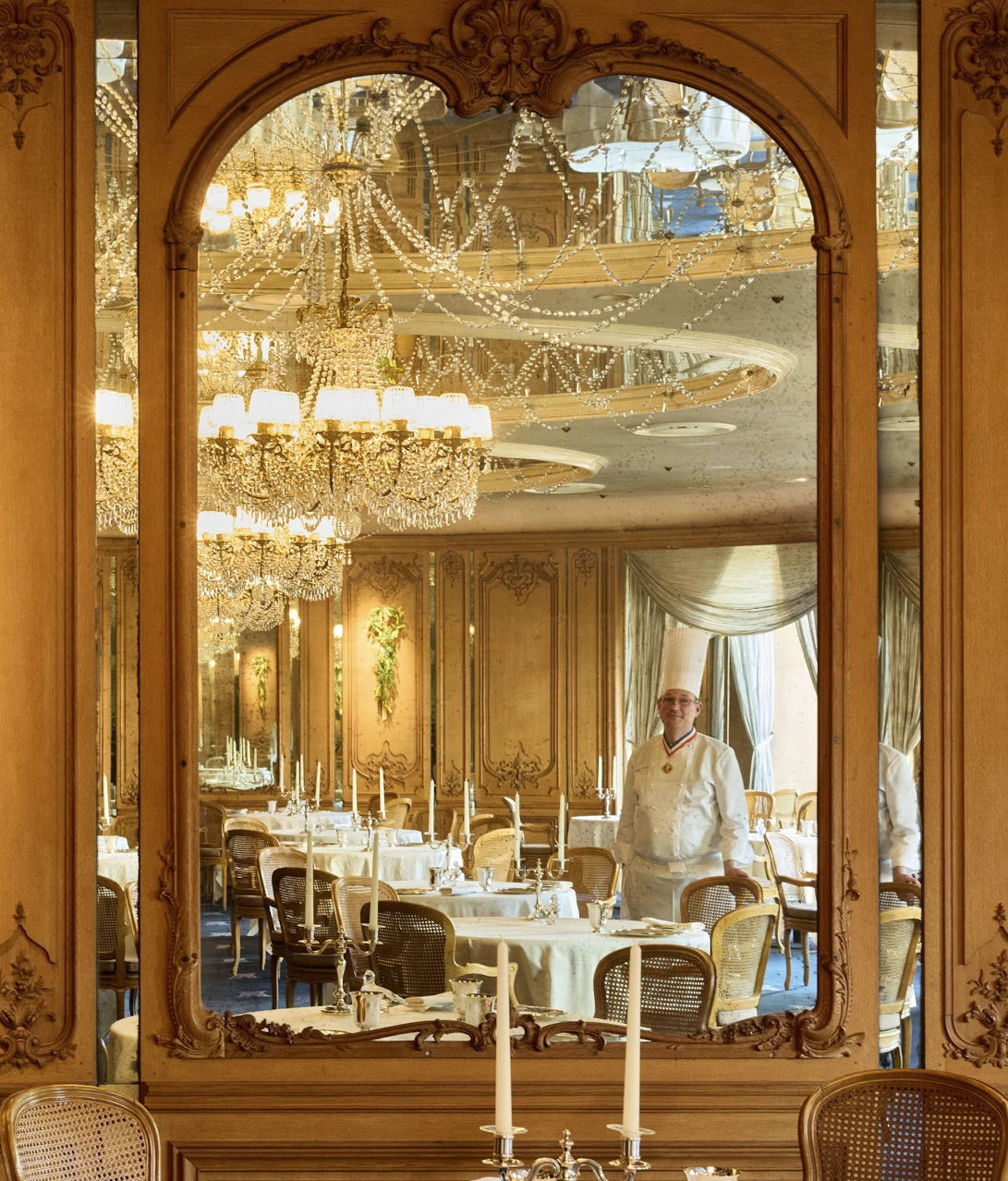
The dining room at La Tour d’Argent Tokyo, with executive chef Renaud Augier reflected in one of its mirrors. © Laura Hodgson
“We are an “enfant de la bulle”, born out of the 1980s Bubble Economy,” explained Christian Bollard, who opened the Tokyo branch of La Tour d’Argent, and has run the restaurant ever since.
The year was 1984 and Japan’s accelerating economy was stoking demand for Western luxuries and trophy assets, from foie gras to French impressionist paintings, Mercedes motor cars and Manhattan real estate. Yoneichi Otani wanted a French restaurant to mark the 20th anniversary of the hotel that had been founded by his late father, the steel magnate Yonetaro Otani. A fortuitous encounter on a flight brought him into contact with Claude Terrail, the charismatic owner of La Tour d’Argent, Paris’ most revered restaurant. It was founded in 1582 and its pressed duck, colossal wine list and views of the apse of Notre Dame had been a draw for well-heeled visitors for generations. A deal was done and Terrail turned to Bollard, a promising young French graduate, to set up the Tokyo branch. While the economic bubble in which the restaurant was born may have long since burst, 42 years later Tour d’Argent Tokyo has lost none of its effervescence, a time capsule as alluring as it is arcane.
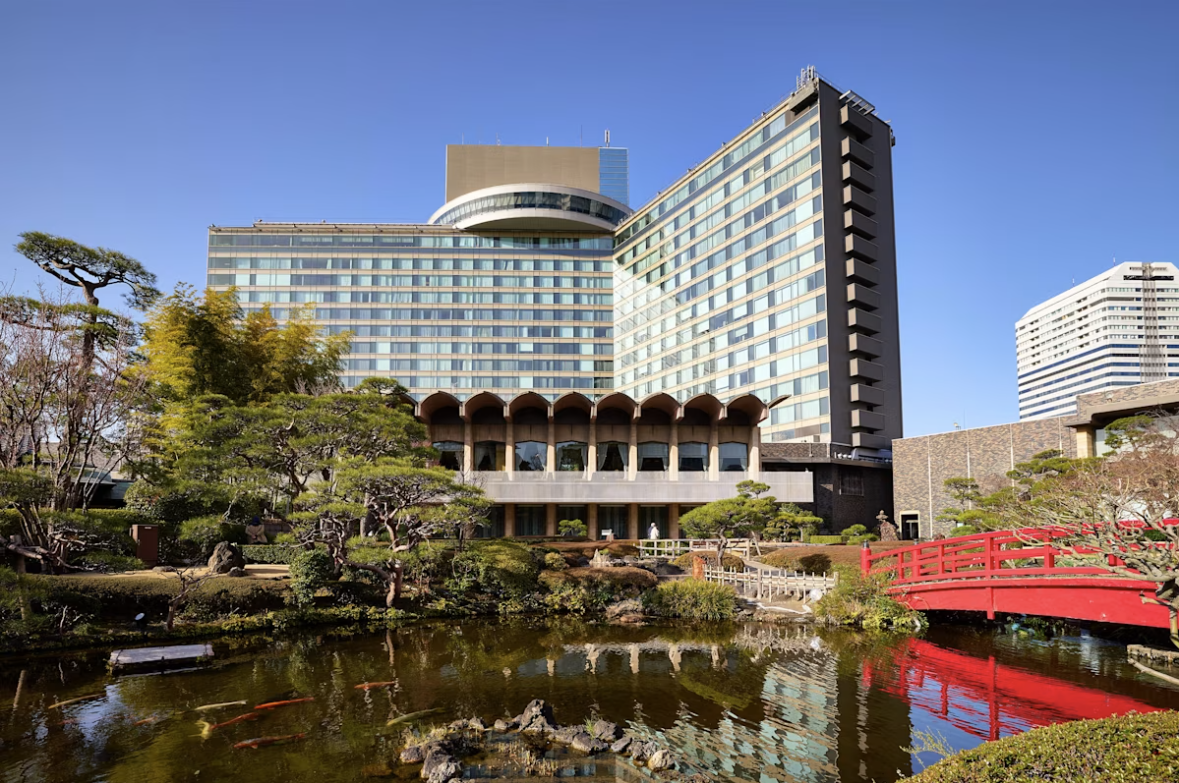
The restaurant sits in a striking brutalist pavilion connected to the base of the Hotel New Otani Tokyo, which Otani built for the 1964 Olympic Games in the historic gardens of his Chiyoda City estate. The hotel’s distinctive curved form, with its rooftop “saucer”, will be familiar to many as the fictional headquarters of the Osato Chemical & Engineering Company, infiltrated by James Bond (played by Sean Connery) as he investigates SPECTRE in You Only Live Twice (1967).
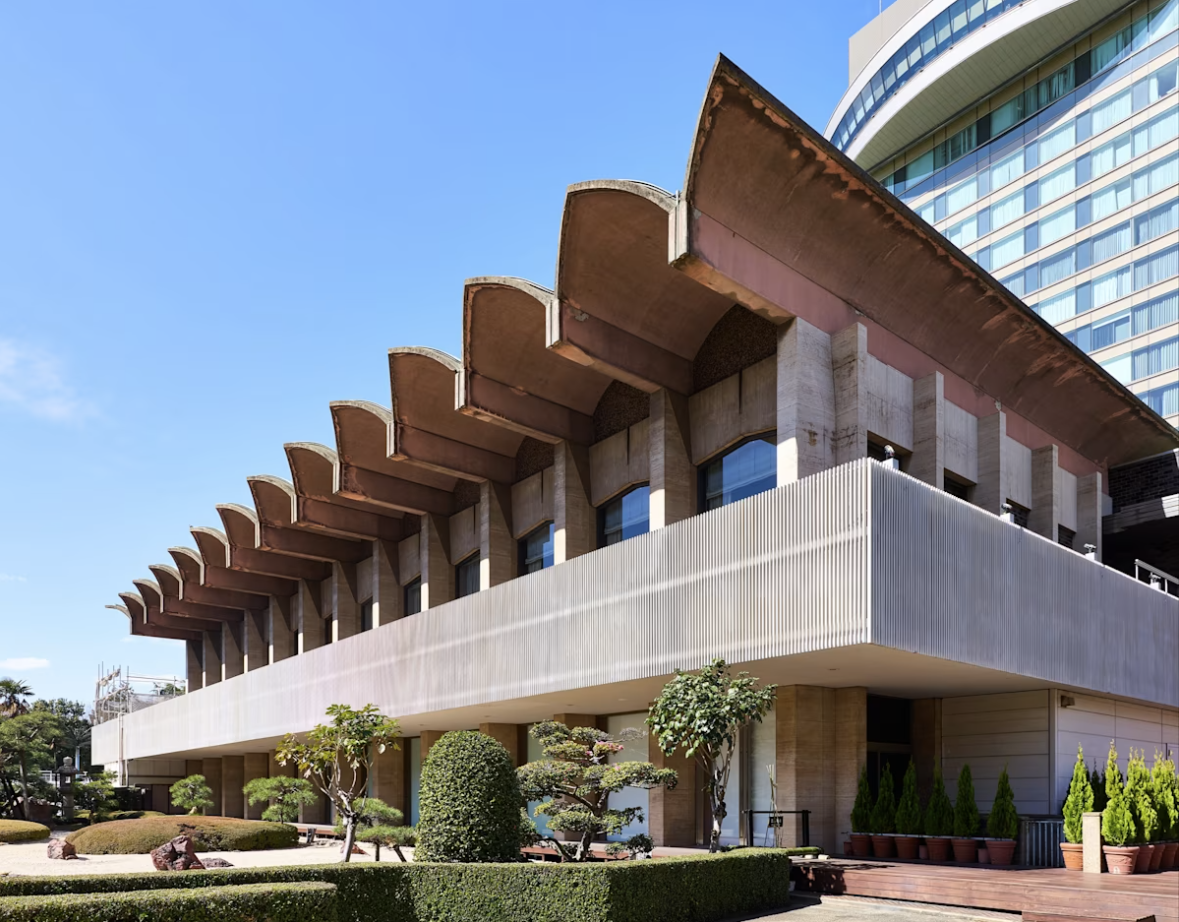
The Brutalist pavilion at the foot of the Hotel New Otani, in which the Tour d’Argent is located. © Laura Hodgson
The hotel itself is a Tokyo institution: a vast complex with its own shopping mall, wedding chapels, medical clinic, some 1,400 rooms and 36 restaurants and bars, ranging from intimate teppanyaki counters to the Polynesian whirl of Trader Vic’s. Pass through a discreet doorway next to the hotel’s Mediterranean-themed Bar Capri, however, and you will find yourself in an exquisite mise-en-scène where pre-revolutionary France and 1980s Japan coexist in surprising harmony, two anciens régimes united by a shared love of gastronomy. The swirl of the grand hotel outside seems far away.
A long, dimly lit vestibule leads to a shimmering equestrian portrait of Henri IV (reputed to have given the restaurant its name) hanging above a Louis XV commode whose ormolu fittings sparkle in the mirrored ceiling.
The Henri IV motif continues into the lobby and the bar. “We chose a House of Bourbon blue for its association with Henri IV, but with the finish of Japanese lacquer,” recounted Bollard. The choice encapsulates the dialogue between French and Japanese traditions that takes place throughout the restaurant, from its decoration to the food itself. The bar is lined with reproductions of renaissance portraits from a 15th-century Loire château, set above velvet Mario Bellini Tentazione armchairs. Ivory-and-gold Louis XVI panelling (and a matching cream piano) breaks the mass of dark blue, marking the threshold of the private dining room. “We had a theatre designer help us,” added Bollard. The effect is cinematic, in this case more Roger Moore than Sean Connery.
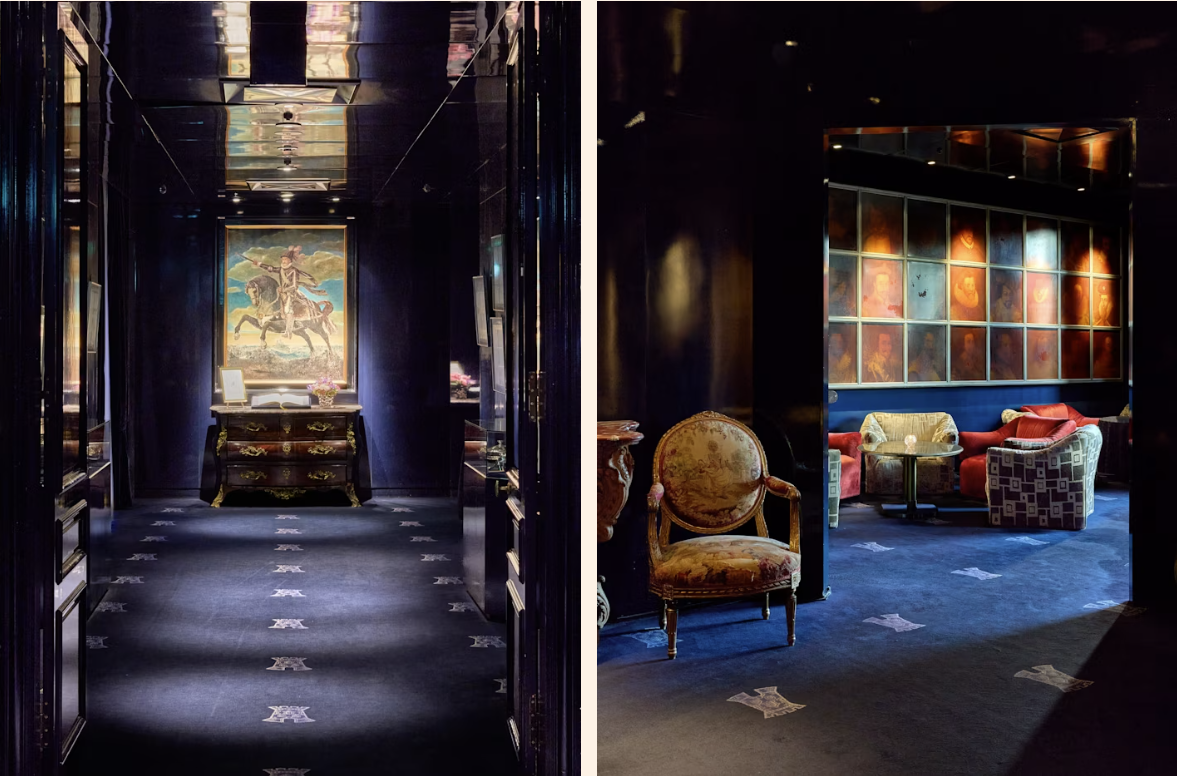
An equestrian portrait of Henri IV hangs above a Louis XV commode in the restaurant’s vestibule.
Reproductions of renaissance portraits line the walls of the bar, which also features armchairs by the Italian architect and designer Mario Bellini. © Laura Hodgson
Assorted treasures fill the restaurant: 18th-century marble-topped commodes; a fork of the type introduced by sophisticated Italians to finger-licking France during the Renaissance; a bucolic view of a French country lane by Albert Marquet hanging alongside other masterpieces from the Otani family collection; and a display of grand old wine bottles.
The climax of this carefully staged interior is the main dining room, lined with Louis XV boiseries. The panelling came from France but required some modification, for which Bollard enlisted traditional Miya-Daiku shrine carpenters. “At first, they were surprised at how the French oak would blunt their tools; they were used to softer woods, like cedar and cypress,” he recalled. “When it came to carving a replacement garland, they sought to replicate the nervosité of French 18th-century carving.” If the Paris restaurant is famous for its views of Notre-Dame, Tokyo’s answer is no less considered: floor-to-ceiling windows look over the Edo-period gardens once owned by the 16th/17th--century samurai lord Kato Kiyomaso, with a hotel tower added in the 1970s rising beyond the trees.
Dinner was a glorious candlelit affair, a proper grand restaurant experience in which detachments of waiters delivered silver-domed dishes before revealing their contents in a display of perfectly timed cloche work. Later, to the strains of Mozart’s 4th Horn Concerto, crumbs would be swept from the tablecloth with equal precision.
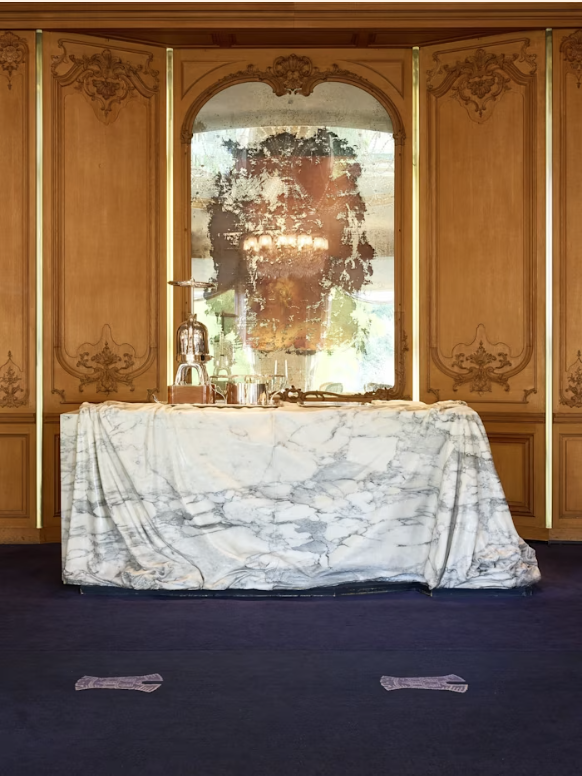
The marble table (with its trompe l’oeil tablecloth) on which the Tour d’Argent’s signature ducks are pressed. © Laura Hodgson
The centrepiece of the dining room is a massive table with what appears to be a billowing cloth sculpted from a single block of marble, on which the carcass of the celebrated Tour d’Argent Challans duck is pressed to release its juices. (The table, on its arrival from Europe, had to be hollowed out as its weight was deemed a safety risk in the event of an earthquake.) In a tradition begun in Paris in 1890, diners receive a card recording the number of the duck they have consumed.
“In the beginning, Monsieur Terrail and I wrestled with whether to start the numbering at 1,” reminisced Bollard. “The Emperor Showa had dined on duck 53,211 on his visit to the Paris restaurant in 1921. We could not have a situation in which someone else could one day also dine on duck 53,211. And so, we decided that, for Tokyo, the numbering would start at 53,212.” Forty-two years later, I found myself dining on duck number 304,171.
Steeped in the traditions of anciens régimes though the Tokyo restaurant may be, its cooking is surprisingly modern. Under head chef (and Meilleur Ouvrier de France) Renaud Augier (now in his 13th year at Tour d’Argent Tokyo), the kitchen strikes a graceful balance between traditional French techniques and exceptional Japanese ingredients. That concinnity has helped the restaurant maintain a Michelin star ever since the guide launched its guide to Japan in 2007.
Mebaru (Japanese Rockfish) served with a subtle white wine and tomato water beurre blanc exemplified this east-meets-west approach. It was exciting to discover the gentle sweetness of an unfamiliar fish but at the same time comforting to encounter the delicate tang of that stalwart of French emulsified sauces – though for the predominantly Japanese clientele, the reverse may well have been true. The dishes were as beautiful as they were flavoursome: the tender orange flesh of char fish was offset by a luminous green chaud-froid of kureson watercress. A truffled quenelle de brochet in a blanket of gold leaf from Kanazawa (a city famous for its gold-leaf production) paid homage to a gold box made by a Ginza jeweller to commemorate the Imperial Couple’s 1971 visit to France, during which they dined at the Paris restaurant. Perfectly rosé slices of duck, whose juices had been blended with fragrant morels, were accompanied by prized Japanese spring ingredients – snow pea (kinusaya) custard and glazed white asparagus.
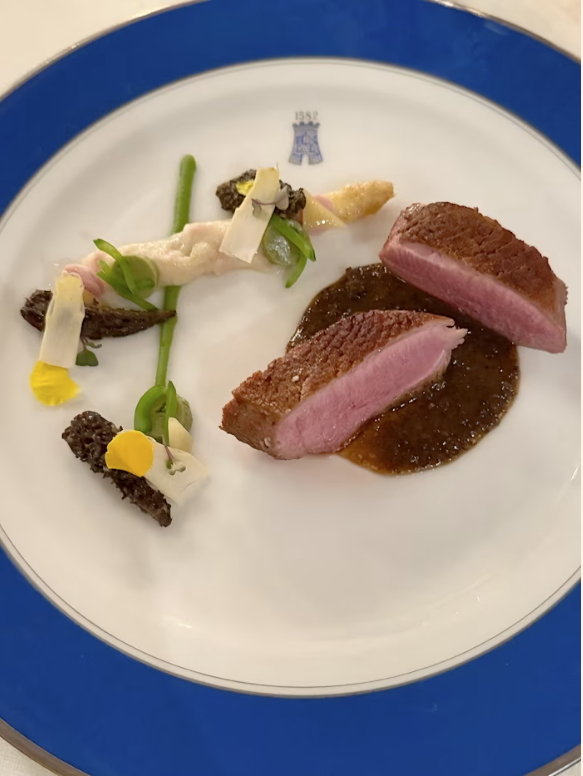
Duck breast with morels, white asparagus and edible flowers. © Laura Hodgson
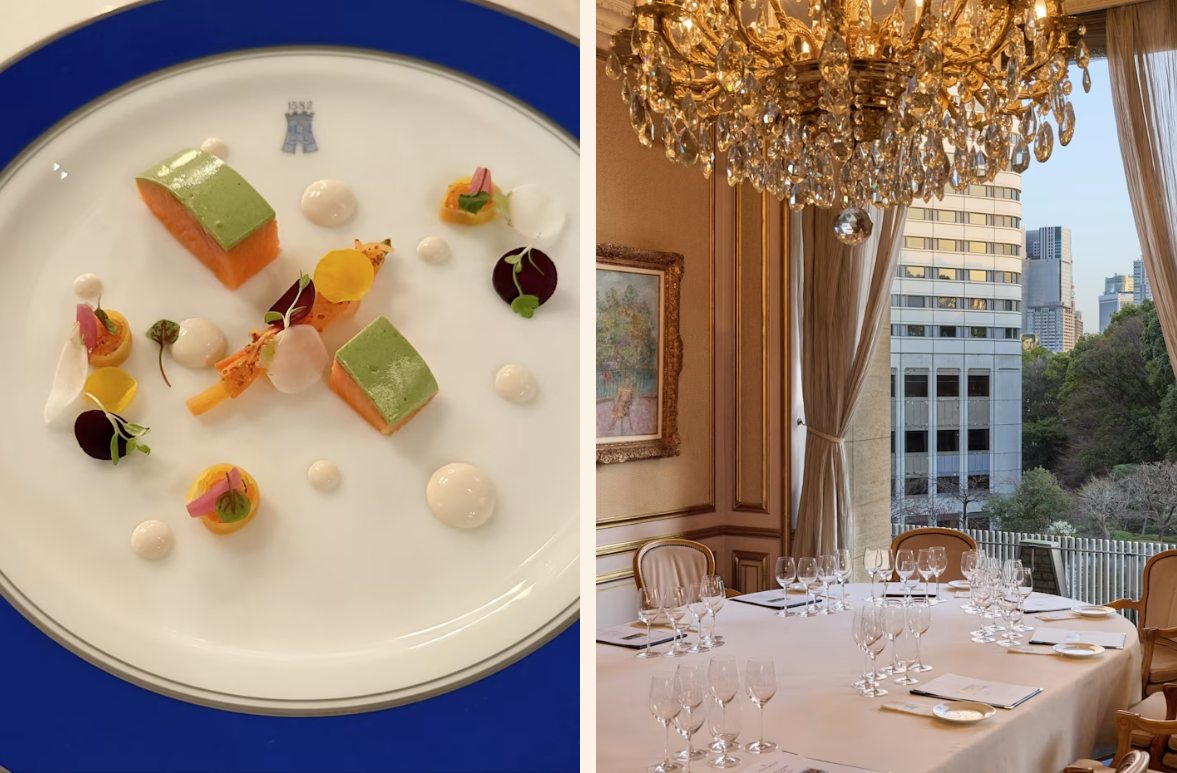
Dishes as beautiful as they are flavoursome’ include char topped with a watercress chaud-froid.
La Tour d’Argent Tokyo offers ‘an exquisite mise-en-scène where pre-revolutionary France and 1980s Japan coexist in surprising harmony’ . © Laura Hodgson
The wine list is no less impressive. In a country where people drink less but better wine than their European counterparts, the restaurant has built a formidable cellar, with a number of 1982s laid down when the restaurant first opened now drinking well. A squad of sommeliers stands ready to guide guests through the list.
I asked Bollard about his clientele. Does a restaurant as refined and elevated as this have regulars?
“Japanese customers are d’uneextrême fidelité, loyal and supportive. Some families have been coming for generations. Clients like the sense of continuity and tradition,” he said. “The other day, I asked a couple why they were choosing us for their wedding. They replied that they had been drawn to the idea of coming back to Tour d’Argent to celebrate their anniversary in 10 years’ time. ‘We know you will always be there.’”